Members area
NEW WEF REPORT POSITIONS PHYSICAL ACTIVITY AS CRITICAL DRIVER OF ECONOMIC RESILIENCE FOR THE $2.3 TRILLION SPORTS ECONOMY
What the World Economic Forum’s Sports for People and Planet Insight Report Means for WFSGI Members

Bern, 15 January 2026:
The World Economic Forum has published its much-anticipated Sports for People and Planet Insight Report in collaboration with Oliver Wyman with clear actions for our membership base across the sporting goods industry.
The report connects participation in sport and physical activity, sustainability and economic performance in a way that directly affects the future growth of our industry.
At its core, the report sends a clear signal: the way that sport and physical activity are enabled today will shape demand, resilience and competitiveness in the immediate future.
WHY THIS REPORT MATTERS FOR OUR INDUSTRY
For the first time, we are provided with a comprehensive picture of the global sports economy, now valued at an est. $2.3 trillion (compiled by WEF knowledge partner Oliver Wyman). Making up a quarter of this impressive economic number is the sporting goods industry, valued at $614 billion with strong growth projected in the years ahead.
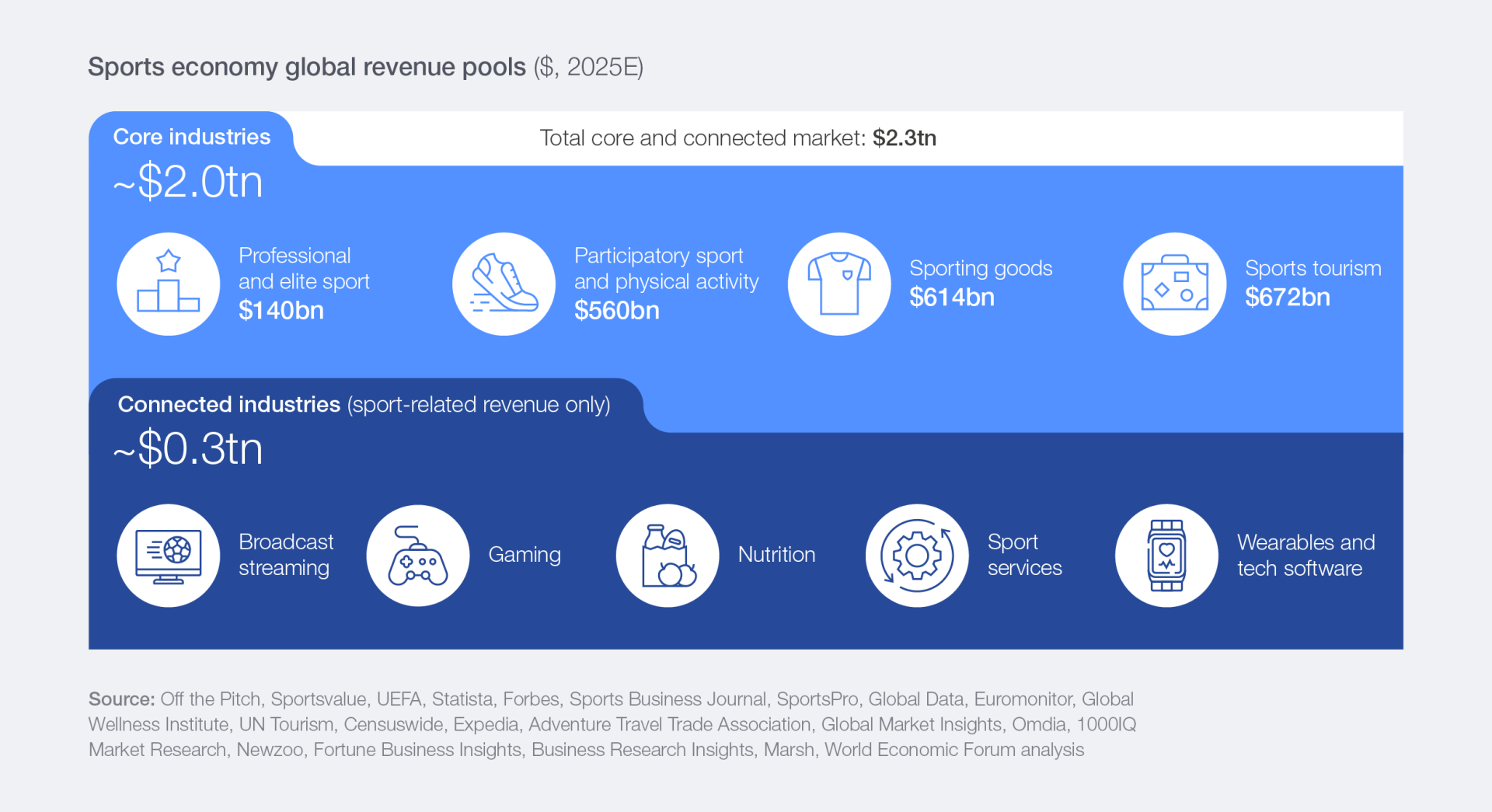
At the same time, the report highlights a concerning, growing gap between demand for sport – and the reality of participation in sport and physical activity on the ground.
Global physical inactivity is increasing, and under current trends the number of people who are physically inactive worldwide could increase to 800 million by 2030. This is not only a public health concern; it directly underpins long-term consumer demand, workforce wellbeing and the sustainability of the broader sports ecosystem.
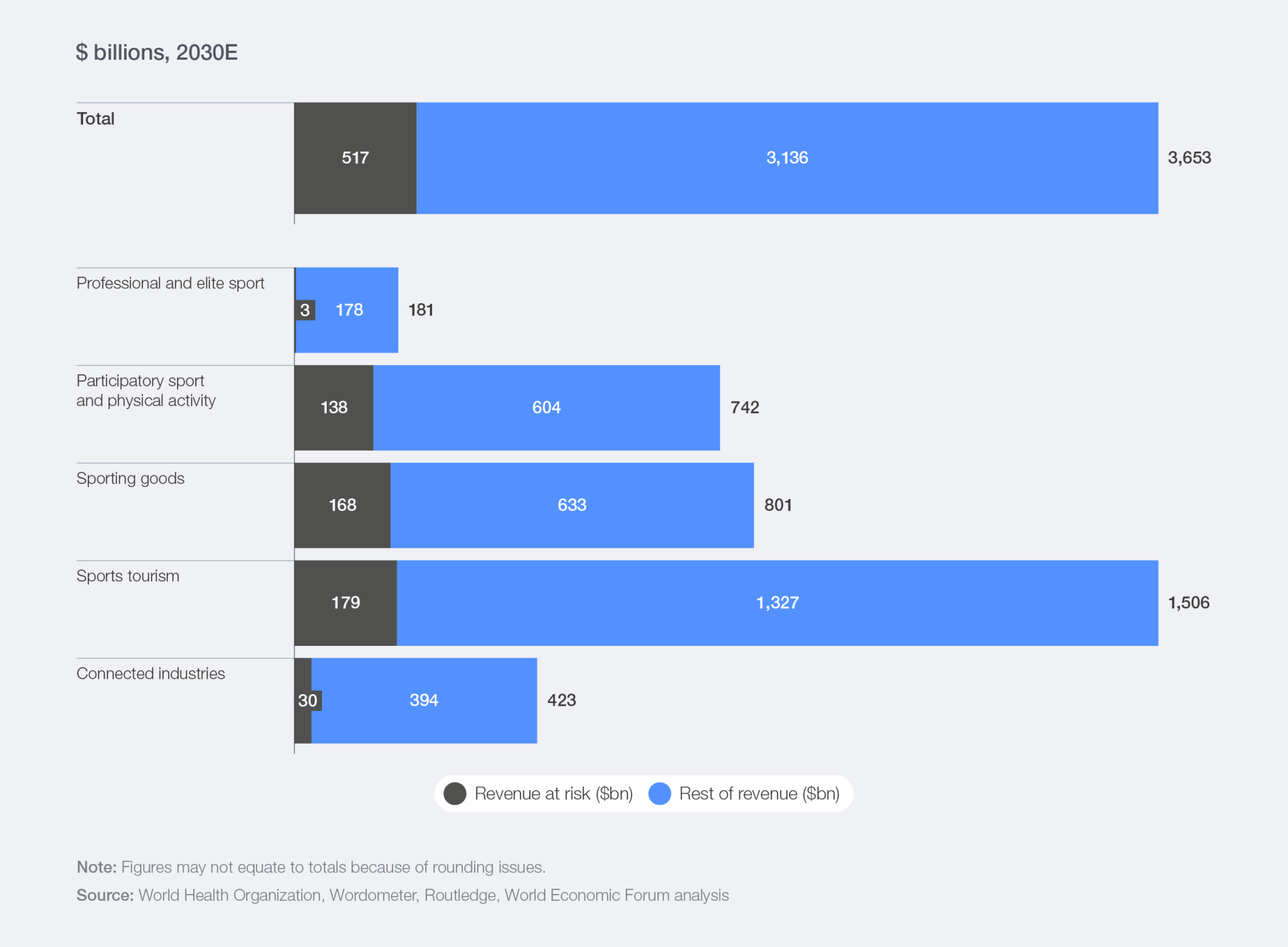
The report estimates the sporting goods industry risks losing $169 billion in projected revenue due to physical inactivity, climate change and nature loss; that’s 27% of industry revenue at risk due to these interconnected pressures.
WHERE THE OPPORTUNITY LIES
However, there is opportunity in every challenge, and the data does not point only to risk – it also points to opportunity. Participation gaps highlight where growth can be unlocked.
One of the clearest examples is gender. In the European Union, women and girls represent just 37% of sports participation. Closing this gap would not only deliver social benefits but would also expand the future consumer base of the sports economy. Products, services and experiences that better reflect the needs, motivations and realities of women and girls represent a significant growth opportunity for industry.
The report also draws attention to the environments in which participation happens. Environmental degradation, extreme weather and poorly designed urban spaces can discourage physical activity and limit access to facilities while it notes these climate stressors disproportionately affect vulnerable groups including women, young people and people with disabilities.
At the same time, cities and communities that prioritise safe, inclusive and climate-resilient spaces enable more people to move, play and participate.
For industry, this reinforces that ESG and sport, physical activity and movement are deeply connected. Environmental action is not separate from growth; it helps determine where and how people are able to be active.
The report also reinforces a simple but powerful idea: sport and physical activity functions as preventive medicine, reducing pressure on healthcare systems and supporting more productive, resilient economies. Yet investment in prevention remains low compared with the scale of non-communicable diseases linked to inactivity and there’s an increasing worry as fiscal priorities of governments shift towards defence and crisis response funding for prevention and community sport risks further erosion.
WHAT THIS MEANS FOR WFSGI MEMBERS
Across the report, one message comes through consistently: companies that succeed in the next phase of growth will be those that enable sport, physical activity and movement.

That can mean working together for better market access for sporting goods, developing circular products, rental models and more sustainable supply chains, partnering with Governments, NGOs, cities and communities on urban planning, sports infrastructure and physical activity programmes or product innovation for underrepresented groups.
Several WFSGI member brands are highlighted in the report for already taking steps in this direction, showing that participation-led approaches are commercially relevant today.
WFSGI is recognised in the report for our collaboration with global partners, including the World Health Organization, reflecting the role the federation plays at the intersection of industry, health and sustainability.
LOOKING AHEAD TO 2026
This report is not a call for more analysis. It is a call for alignment and action.
For the sporting goods industry, the challenge and the opportunity, is to scale what works – to invest in supporting the world to move more, tackling the physical inactivity crisis and further advancing ESG commitments.
As governments rethink preventive healthcare, cities redesign public spaces and consumers increasingly value purpose alongside performance, the industry has a clear role to play. Expanding sport, physical activity, movement and ESG initiatives is not only the right thing to do – it is central to building resilient, future-proof growth.
HOW TO GET INVOLVED
Click HERE to learn more about the WFSGI Physical Activity Committee and contact Caroline Brooks via cbrooks@wfsgi.org to get involved
Click HERE to learn more about the WFSGI ESG Committee and contact Afsah Alumia-Khan to get via akhan@wfsgi.org to get involved

 XENER & by ATEX is the Made in Italy excellence in the design and production of lithium battery packs, BMS, motor drivers, integrated with IoT technologies, for the e-mobility industry and off-grid devices.
 McKinsey & Company is a consulting firm advising on strategic management to corporations, governments, and other organizations. WFSGI partnered with McKinsey & Company to support its members in understanding their business environment and take the right business decisions. Among others, sports brands and retailers have been advised on how to cope with the “new normal” that is shaping as a result of the Covid-19 pandemic.
 Gominga provides a software solution that enables tool-based interaction with the customer: review management in one-stop shop and on various eBusiness platforms. WFSGI partnered with Gominga to support its members in managing online product reviews.